The Israelites entered the Promised Land when they crossed the Jordan River (Joshua 3). This is not only a historical, geographical fact, it's also a picture/foreshadowing of Christians crossing into heaven after a pilgrimage through the wilderness of life.
Jesus was baptized in the Jordan River. I always thought that was because [duh] the Jordan River just happened to be the one that was available for John the Baptist. A simple fact of geography and nothing more.
But it IS more. We are joined to Him in His death and resurrection (Romans 6). In His baptism, He takes our sin upon Himself and gives us His righteousness. This is our entry into the promised land. Baptism is when the Father says also to us, "This one is My beloved son."
Jesus was baptized in the Jordan River.
A simple fact of geography.
And a big, sweet, beautiful theological truth
of what has been
and of what is yet to come.
Showing posts with label baptism. Show all posts
Showing posts with label baptism. Show all posts
Friday, February 20, 2015
Friday, April 11, 2014
Matthias's Baptism
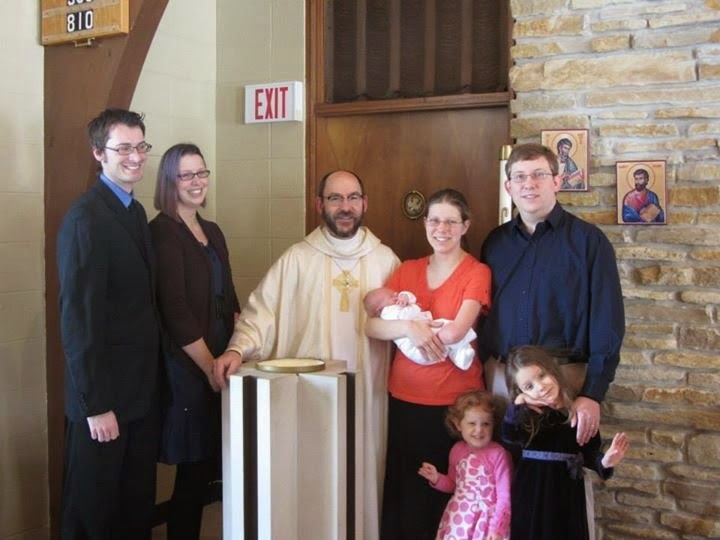
Okay, so it's a six-week-old picture
that I should've posted a long time
ago. I'm behind...
Thursday, March 13, 2014
The Blood of the Passover
Blood on the doorposts and lintels.
The Angel of Death passed over those houses.
Maybe it was pictures from Sunday School lessons.
Maybe it was something I saw in a movie.
I always pictured in my mind the people painting the blood onto their door-frames. You know, smearing it on in a rather tidy, complete way.
But Exodus 12 says the people were to dip the hyssop in the blood of the lamb and "strike [or touch] the lintel and the two doorposts with the blood." The lintel. The two doorposts. That makes three applications of blood.
What happens in baptism?
I baptize you in the name of the Father
[splash]
and of the Son
[splash]
and of the Holy Ghost.
[splash]
The Angel of Death passed over those houses.
Maybe it was pictures from Sunday School lessons.
Maybe it was something I saw in a movie.
I always pictured in my mind the people painting the blood onto their door-frames. You know, smearing it on in a rather tidy, complete way.
But Exodus 12 says the people were to dip the hyssop in the blood of the lamb and "strike [or touch] the lintel and the two doorposts with the blood." The lintel. The two doorposts. That makes three applications of blood.
What happens in baptism?
I baptize you in the name of the Father
[splash]
and of the Son
[splash]
and of the Holy Ghost.
[splash]
Tuesday, March 26, 2013
The Power of Baptism
There's something in Narnia that always confused me. Always. In The Last Battle, at the end of the book, one of the Calormenes ends up in Aslan's Country. (In case you've never read the books, this suggests that devotees of a false god will be saved if they have misunderstood their god and imagined him to be like the true God, so that they were kinda sorta worshiping the true God even though they didn't know Him by His true name.)
What would this say about baptism?
Is what we think about God the important thing, the main thing? What about baptism, where God places His name upon us?
Can people misunderstand what their religion teaches, believing falsely when the truth is taught, OR believing rightly when falsehoods are taught? Yes, obviously. Can people die in the faith prior to receiving the gift of baptism? Yes, of course. But what happens in baptism --to be made a child of God-- is no small potatoes. It makes a difference. It changes who we are. It gives us access to God.
And I can't figure out how that fits with this tiny section of The Last Battle of Narnia.
What would this say about baptism?
Is what we think about God the important thing, the main thing? What about baptism, where God places His name upon us?
Can people misunderstand what their religion teaches, believing falsely when the truth is taught, OR believing rightly when falsehoods are taught? Yes, obviously. Can people die in the faith prior to receiving the gift of baptism? Yes, of course. But what happens in baptism --to be made a child of God-- is no small potatoes. It makes a difference. It changes who we are. It gives us access to God.
And I can't figure out how that fits with this tiny section of The Last Battle of Narnia.
Wednesday, October 24, 2012
Demon Possession
"Can a Christian be demon possessed?" I've lost count of how many times I've heard people ask that question. And this week I heard a most awesome answer.
Christians can and will be attacked by the demons. That's not possession; it's an attack. A person may wonder if it's demon-possession. It may feel the same. It may appear to be the same. But in the end, does it matter if we know whether it's an attack or possession? After all, the remedy is the same thing: "Depart, you unclean spirit, and make room for the Holy Spirit!" ... and then the comfort of the forgiveness of sins for Jesus' sake is applied to the afflicted one.
How awesome is that?!
Christians can and will be attacked by the demons. That's not possession; it's an attack. A person may wonder if it's demon-possession. It may feel the same. It may appear to be the same. But in the end, does it matter if we know whether it's an attack or possession? After all, the remedy is the same thing: "Depart, you unclean spirit, and make room for the Holy Spirit!" ... and then the comfort of the forgiveness of sins for Jesus' sake is applied to the afflicted one.
How awesome is that?!
Monday, October 15, 2012
Baptismal Pooping
What is it with my kids? "Receive the sign of the holy cross," and some water connected to "I forgive you all your sins in the name of the Father and of the Son and of the Holy Ghost" ... and they filled their diapers to overflowing.*
Twenty-three years ago today my baby spent the church service wrapped in a kitchen towel. You'd have thought, by this point, that on a baptism Sunday I'd tuck a change of clothes into the diaper bag. But no. I forgot. And Paul outpooped the poops of all his older sibs. After the baptism rite, I bathed the other end of the kid, snagging a dish towel from the kitchen drawer so he wouldn't be cold and naked.
Also on this day 23 years ago we sang "Oh, How Great Is Thy Compassion" for the baptism hymn. Pastor Wieting initially thought it was the oddest request he'd ever had for a baptism hymn. Really? "And in our deep degradation, Thou hadst mercy so that we might be saved eternally." Ah, yes, it works just dandy as a baptism hymn. I'll sing it again today. Maybe others in the family will too.
* Except for the two youngest.
Twenty-three years ago today my baby spent the church service wrapped in a kitchen towel. You'd have thought, by this point, that on a baptism Sunday I'd tuck a change of clothes into the diaper bag. But no. I forgot. And Paul outpooped the poops of all his older sibs. After the baptism rite, I bathed the other end of the kid, snagging a dish towel from the kitchen drawer so he wouldn't be cold and naked.
Also on this day 23 years ago we sang "Oh, How Great Is Thy Compassion" for the baptism hymn. Pastor Wieting initially thought it was the oddest request he'd ever had for a baptism hymn. Really? "And in our deep degradation, Thou hadst mercy so that we might be saved eternally." Ah, yes, it works just dandy as a baptism hymn. I'll sing it again today. Maybe others in the family will too.
* Except for the two youngest.
Thursday, September 08, 2011
Emergency Baptism
There's disagreement out there on the topic of whether healthy babies should be baptized right after birth or if it's better to wait until the child can come to one of the services of the Church. There is, however, no disagreement about baptizing a baby who is in imminent danger.
My mom was a nursery nurse. Sometimes she would baptize babies. However, not everybody knows that it's not only okay, but good, for a layman to baptize a baby in an emergency. Sometimes we think such things "go without saying." But they don't; they need to be said -- in this situation, it is not disrespectful to the pastoral office to baptize the child yourself. So I just want to mention this right now, for my young readers who may be having children in the coming years, as well as for those of y'all who are in the medical field and may have the opportunity to be around at your patient's end.
Friday morning is a funeral for two little boys for whom Jesus died. We grieve with their parents.
My mom was a nursery nurse. Sometimes she would baptize babies. However, not everybody knows that it's not only okay, but good, for a layman to baptize a baby in an emergency. Sometimes we think such things "go without saying." But they don't; they need to be said -- in this situation, it is not disrespectful to the pastoral office to baptize the child yourself. So I just want to mention this right now, for my young readers who may be having children in the coming years, as well as for those of y'all who are in the medical field and may have the opportunity to be around at your patient's end.
Friday morning is a funeral for two little boys for whom Jesus died. We grieve with their parents.
Friday, December 03, 2010
Miscarriage and "The Necessity of Baptism"
So Wednesday morning in chapel (after Rachel called about the baby but while there was still a smidge of hope that the ultrasound might find a heartbeat), we prayed in the Great Litany for expectant mothers. And then on Thursday morning we had the story of Leah and Rachel and their children. And then during Bible class we discussed the article in the Augsburg Confession on baptism and how baptism is "necessary for salvation."
Bonnie asked about the thief on the cross. Pastor's mini-answer was that we don't know he wasn't baptized. But then the main answer: even if he wasn't, Jesus said, "Today you will be with Me in paradise." Jesus' word is what matters!! Pastor also pointed out that "without God's word, the water is plain water, but with the Word of God, it is a baptism, that is, a life-giving water." In other words, it is the Word which makes baptism what it is. It is the Word that has the power. It is the Word of God which saves, which imparts faith, which forgives sin.
I had to ask after class about little babies who die before baptism. In my intellect, I knew the answer. But I still needed to hear the answer.
Pastor re-spoke what he had said in class about the malefactor on the cross. He reminded me of God's desire to save the baby and that this child's lack of baptism would not thwart God's eternal plan. He reminded me that the baby had been hearing God's word. (And none of that "but the baby doesn't have ears yet." Go look at Romans 10:17 and all the stories where Jesus healed the deaf -- God's word creates hearing even when the person doesn't have the physical equipment to hear the gospel which is being preached to him.)
Pastor pointed out 1 Corinthians 7:14, where it says the unbelieving wife is sanctified by her Christian husband, and the unbelieving husband is sanctified by his Christian wife, and how their children are holy. He reminded me that "the Word of God is the only holy thing we have" and that is what Paul is referring to in his advice on marriage. But this also means that the Word of God spoken and sung in the lives of the parents is how the Holy Spirit is working faith in their children, "when and where He pleases, in those who hear the Gospel. And the Gospel teaches that we have a gracious God, not by our own merits, but by the merits of Christ, when we believe this."
And for the sake of my small brain which needs pictures and illustrations and simple explanations, he gave me an analogy. Nutrition is necessary that the baby might grow and live physically. Babies get their nutrition by suckling at the breast. But does that mean they don't get any nutrition before birth, just because they cannot yet suckle? Of course not. How silly. Things are different before birth. God provides nutrition in a different way prior to birth. In the same way, Jesus' blood is necessary to cover sin. God's Word delivers His atonement to us. But there are some differences in how that merciful blood is delivered to us before and after birth. (Okay, it's not a perfect analogy. But it's good. And it helps.)
Jesus took on human flesh in the womb of His mother Mary. He joined Himself to us that He might save His little brothers, even the ones still in the womb. "He was little, weak, and helpless. Tears and smiles like us He knew. And He feeleth for our sadness. And He shareth in our gladness." He became man and died for our sin that our babies might have the forgiveness of sins, the resurrection of the body, and the life everlasting. For the promise IS "to you and to your children."
Okay, y'all didn't need to hear that, I suspect. But I needed to write it out.
Bonnie asked about the thief on the cross. Pastor's mini-answer was that we don't know he wasn't baptized. But then the main answer: even if he wasn't, Jesus said, "Today you will be with Me in paradise." Jesus' word is what matters!! Pastor also pointed out that "without God's word, the water is plain water, but with the Word of God, it is a baptism, that is, a life-giving water." In other words, it is the Word which makes baptism what it is. It is the Word that has the power. It is the Word of God which saves, which imparts faith, which forgives sin.
I had to ask after class about little babies who die before baptism. In my intellect, I knew the answer. But I still needed to hear the answer.
Pastor re-spoke what he had said in class about the malefactor on the cross. He reminded me of God's desire to save the baby and that this child's lack of baptism would not thwart God's eternal plan. He reminded me that the baby had been hearing God's word. (And none of that "but the baby doesn't have ears yet." Go look at Romans 10:17 and all the stories where Jesus healed the deaf -- God's word creates hearing even when the person doesn't have the physical equipment to hear the gospel which is being preached to him.)
Pastor pointed out 1 Corinthians 7:14, where it says the unbelieving wife is sanctified by her Christian husband, and the unbelieving husband is sanctified by his Christian wife, and how their children are holy. He reminded me that "the Word of God is the only holy thing we have" and that is what Paul is referring to in his advice on marriage. But this also means that the Word of God spoken and sung in the lives of the parents is how the Holy Spirit is working faith in their children, "when and where He pleases, in those who hear the Gospel. And the Gospel teaches that we have a gracious God, not by our own merits, but by the merits of Christ, when we believe this."
And for the sake of my small brain which needs pictures and illustrations and simple explanations, he gave me an analogy. Nutrition is necessary that the baby might grow and live physically. Babies get their nutrition by suckling at the breast. But does that mean they don't get any nutrition before birth, just because they cannot yet suckle? Of course not. How silly. Things are different before birth. God provides nutrition in a different way prior to birth. In the same way, Jesus' blood is necessary to cover sin. God's Word delivers His atonement to us. But there are some differences in how that merciful blood is delivered to us before and after birth. (Okay, it's not a perfect analogy. But it's good. And it helps.)
Jesus took on human flesh in the womb of His mother Mary. He joined Himself to us that He might save His little brothers, even the ones still in the womb. "He was little, weak, and helpless. Tears and smiles like us He knew. And He feeleth for our sadness. And He shareth in our gladness." He became man and died for our sin that our babies might have the forgiveness of sins, the resurrection of the body, and the life everlasting. For the promise IS "to you and to your children."
Okay, y'all didn't need to hear that, I suspect. But I needed to write it out.
Wednesday, April 28, 2010
Access to the Father

Romans 3 -- In Christ Jesus we have boldness and access with confidence through faith in Him.
Pastor loves to refer to this picture of President Kennedy. He uses it to illustrate our privileged status as the sons of God. You and I cannot go visit the President whenever we want. We don't have the right to do that. But John John? He could crawl around under his daddy's desk, climb into his daddy's lap, or whatever. He had special privilege because he was his daddy's son. He had access that reporters and politicians didn't have.
Once upon a time, when I still didn't know very many pastors, we were at a district pastors' conference. The featured speaker for the conference was Robert Preus. Gary and I were at dinner at a restaurant. At a table not far from our booth were all the bigwigs: Dr Preus and our district president and some other men. There was one young whippersnapper, not much older than us, in there with the gang of revered men. I didn't know who he was or why he "rated." Later, Gary introduced me to Rolf. Oh, I get it. He "rated" because he was at supper with his daddy and his daddy's cohorts. He had access to that dinner table that not everyone had. He was a son.
We have access to God. Yes, He is the King of the Universe. Yes, we respect Him. But we have boldness of access as His sons.
When the car was in the shop recently and I had to figure out ways to get around, our mechanic let me have his loaner car for a day. I had access to a vehicle without figuring out whether I was going to walk, bike-ride, or hitch a ride from a friend. It made everything so much simpler.
When our friend Leah is visiting our house and needs to use the computer, she doesn't sit down and start web-surfing. She asks first. She needs to have us input the password to open the computer to her. But Maggie and Andrew? They pretty much have free access to my computer.
I have access to my mother's house in a way that I wouldn't have if she had moved away from the home where I grew up. I feel comfortable there and know where a lot of things are stored, even decades later.
When I finally got the car back, all nice and repaired, I was struck by how much freedom it gives me to have full & free access to that vehicle. I don't have to ask anybody to use it. I don't have to borrow keys. I don't have to worry about whether somebody is going to be upset because I put too many miles on it. I have free access to that hunk o' metal.
Because of baptism, because we have the status as sons of God, we have free access to speak to the King of the Universe, that He will hear us, that He will give us an abundance of good gifts. That throne room of heaven is ours and we have every right to be there bending His ear.
Therefore, brethren, having boldness to enter the Holy of Holies by the blood of Jesus, by a new and living way which He consecrated for us, through the veil, that is, His flesh, and having a High Priest over the house of God, let us draw near with a true heart in full assurance of faith, having our hearts sprinkled from an evil conscience and our bodies washed with pure water. (Hebrews 10:19-22)
Sunday, April 26, 2009
Infant Faith
In the notes on the baptismal rite, our hymnal tells us that
When the candidate is unable to speak,
sponsors may be appointed
to speak in his or her stead.
The pastor addresses the questions ("Do you renounce the devil?" ... "Do you believe in Jesus Christ?" ...) to the baptismal candidate. Not to the sponsors. The sponsors are not answering the questions, although they are voicing the answers. It is the child who is answering the questions, through the voice of the sponsors.
This is not something new. This is the catholic position. This is what I've been taught all my life as a Lutheran. When I was taught in Sunday School about my baptism, the teachers told me that what happened in baptism was mine. It wasn't something done in view of a faith I would have someday. It wasn't something that belonged to my parents and thus would be my heritage too. It was my own.
Because of this, I am always astounded when I hear pastors say of children they themselves have baptized in recent months, "We don't know what this baby believes. He hasn't told us; he can't tell us."
This came up again last week in a conversation on a friend's blog. On the one hand, we say that of course infants can have faith. We say that God brings babies to faith, makes them alive in Him, and joins them to Himself, all through His grace and not through any merit of their own. Just as He does for me and for you. But the same pastors will turn around and say that we don't know what the child believes.
We say that the confession of sin and the confession of faith made in Baptism is the child's very own confession. And then we say two or three months later that we haven't heard this child's confession to be able to ascertain what he believes. Well? Which is it? It is the child's confession or is it not?
I think we don't take seriously what's going on in Baptism.
When the candidate is unable to speak,
sponsors may be appointed
to speak in his or her stead.
The pastor addresses the questions ("Do you renounce the devil?" ... "Do you believe in Jesus Christ?" ...) to the baptismal candidate. Not to the sponsors. The sponsors are not answering the questions, although they are voicing the answers. It is the child who is answering the questions, through the voice of the sponsors.
This is not something new. This is the catholic position. This is what I've been taught all my life as a Lutheran. When I was taught in Sunday School about my baptism, the teachers told me that what happened in baptism was mine. It wasn't something done in view of a faith I would have someday. It wasn't something that belonged to my parents and thus would be my heritage too. It was my own.
Because of this, I am always astounded when I hear pastors say of children they themselves have baptized in recent months, "We don't know what this baby believes. He hasn't told us; he can't tell us."
This came up again last week in a conversation on a friend's blog. On the one hand, we say that of course infants can have faith. We say that God brings babies to faith, makes them alive in Him, and joins them to Himself, all through His grace and not through any merit of their own. Just as He does for me and for you. But the same pastors will turn around and say that we don't know what the child believes.
We say that the confession of sin and the confession of faith made in Baptism is the child's very own confession. And then we say two or three months later that we haven't heard this child's confession to be able to ascertain what he believes. Well? Which is it? It is the child's confession or is it not?
I think we don't take seriously what's going on in Baptism.
Friday, March 13, 2009
Sign of the Cross
From the baptismal liturgy:
Receive the sign of the holy cross,
both upon your forehead
and upon your breast,
to mark you as one redeemed by Christ the crucified.
Lily goes about her day, playing dress-up and drawing pictures and eating her sandwich. The sign of the cross is there, on her forehead, though not visible to the eye. I saw her pastor put it there on the day of her baptism. It's there.
Frederick likewise goes about his day, playing cars and helping Mommy with his baby sister. The sign of the holy cross is on his forehead too.
When you leave your dad's hospital room, and give him a good-night kiss on the forehead, there too is the sign of the holy cross on his forehead. It's been there a good deal longer than has Lily's or Fredo's. But that's okay -- it's meant to be there for all eternity. It doesn't wear off.
The angels see the cross on my forehead. The demons see it too. But we humans don't. At least, not with our eyeballs. We see it only by faith. (Well, except on Ash Wednesday.)
That's why we cross ourselves.
As a way to "see" it.
When a person goes to confession, the pastor says, "I forgive you all your sins in the name of the Father and of the Son and of the Holy Spirit" as he traces that cross (received first in baptism) upon the person's forehead once again.
When we cross ourselves at the beginning of the Service ("In the name of the Father and of the Son and of the Holy Spirit") it's because we have been baptized and are gathered in the name of the God to whom we are all joined. The sign of the cross is the sign that we have been baptized into His death. And when we cross ourselves at the end of the Creed ("the resurrection of the body, and the life everlasting") it's because, if we have been united together in the likeness of His death, we shall also surely be united in the likeness of His resurrection.
When we cross ourselves at the end of the Lord's Prayer ("deliver us from evil") it's because the cross is what delivers us from evil, and our baptism is what assures that deliverance for us.
Sometimes instead of the "regular" sign of the cross, I need to trace the little cross on my forehead and the little cross over my heart. It helps me remember that this business of signing myself is about baptism -- that it is the absolution applied to this mortal flesh -- and that God made these marks on me when He claimed me, even if I was too little to remember it. When I'm praying the psalms, the sign of the cross helps teach me that these prayers are what I can say because I am united to Christ.
It's a wonder, sometimes, to look around the nave and "see" the cross on the foreheads of the saints gathered there. Some of us touch that cross as we "cross ourselves" and some of us don't. But the mark that shows that we have been claimed by King of the Universe, claimed as His sons, is there for all the angelic realm to see. If only I could remember what it means as easily as they can see it.
Receive the sign of the holy cross,
both upon your forehead
and upon your breast,
to mark you as one redeemed by Christ the crucified.
Lily goes about her day, playing dress-up and drawing pictures and eating her sandwich. The sign of the cross is there, on her forehead, though not visible to the eye. I saw her pastor put it there on the day of her baptism. It's there.
Frederick likewise goes about his day, playing cars and helping Mommy with his baby sister. The sign of the holy cross is on his forehead too.
When you leave your dad's hospital room, and give him a good-night kiss on the forehead, there too is the sign of the holy cross on his forehead. It's been there a good deal longer than has Lily's or Fredo's. But that's okay -- it's meant to be there for all eternity. It doesn't wear off.
The angels see the cross on my forehead. The demons see it too. But we humans don't. At least, not with our eyeballs. We see it only by faith. (Well, except on Ash Wednesday.)
That's why we cross ourselves.
As a way to "see" it.
When a person goes to confession, the pastor says, "I forgive you all your sins in the name of the Father and of the Son and of the Holy Spirit" as he traces that cross (received first in baptism) upon the person's forehead once again.
When we cross ourselves at the beginning of the Service ("In the name of the Father and of the Son and of the Holy Spirit") it's because we have been baptized and are gathered in the name of the God to whom we are all joined. The sign of the cross is the sign that we have been baptized into His death. And when we cross ourselves at the end of the Creed ("the resurrection of the body, and the life everlasting") it's because, if we have been united together in the likeness of His death, we shall also surely be united in the likeness of His resurrection.
When we cross ourselves at the end of the Lord's Prayer ("deliver us from evil") it's because the cross is what delivers us from evil, and our baptism is what assures that deliverance for us.
Sometimes instead of the "regular" sign of the cross, I need to trace the little cross on my forehead and the little cross over my heart. It helps me remember that this business of signing myself is about baptism -- that it is the absolution applied to this mortal flesh -- and that God made these marks on me when He claimed me, even if I was too little to remember it. When I'm praying the psalms, the sign of the cross helps teach me that these prayers are what I can say because I am united to Christ.
It's a wonder, sometimes, to look around the nave and "see" the cross on the foreheads of the saints gathered there. Some of us touch that cross as we "cross ourselves" and some of us don't. But the mark that shows that we have been claimed by King of the Universe, claimed as His sons, is there for all the angelic realm to see. If only I could remember what it means as easily as they can see it.
Tuesday, January 27, 2009
One Greater Than Jonah
Today's story on baptism is from Jonah. As we read the story this morning, Pastor was pointing out similarities between the story of Jonah and the story of Jesus, particularly the story about the disciples in the boat during the storm (Mark 4). One of the items he mentioned was the 14th verse of chapter 1, where Jonah's shipmates pray to Yahweh before pitching Jonah into the stormy seas of God's judgment, begging Him not to to hold this sin against them and not to charge his innocent blood to them. Almost makes a person think of Pilate (Matthew 27).
Thursday, December 11, 2008
Psalm 87
This psalm had always drawn my mind back to the hymn, "Glorious Things of You Are Spoken." What I'd always noticed before was the specialness of Zion.
But what is all this stuff about being born in Zion? Three times it says that.
I will make mention of Rahab and Babylon
to those who know Me.
Behold, o Philistia and Tyre, with Ethiopia:
"This one was born there."
And of Zion it will be said,
"This one and that one were born in her;
and the Most High Himself shall establish her."
The Lord will record,
when He registers the peoples:
"This one was born there."
Both the singers and the players on instruments say,
"All my springs are in you."
Somehow, some way, there must be something important about that "being born there." And interestingly enough, the psalm states that three times. Three. Such a trinitarian number.
But then there's that business about the Lord recording births in Zion. The Lord registers the people according to their birth in Jerusalem? What's up with that? Hmmmm. John clues us in (end of Revelation 20) that there is a Book of Life, and anyone whose name is not found written in the Book of Life will be cast into the lake of fire.
Wait a minute. Birth!
Unless one is born again,
he cannot enter the kingdom of God.
Ah ha! So THAT is what the final verse of Psalm 87 has to do with the rest of it. The springs --the waters of Holy Baptism-- are in Zion, the Church. We who are born in the Church --born of water and the Spirit-- are recorded in the Book of Life. And this is the "glorious thing" about Zion!
But what is all this stuff about being born in Zion? Three times it says that.
I will make mention of Rahab and Babylon
to those who know Me.
Behold, o Philistia and Tyre, with Ethiopia:
"This one was born there."
And of Zion it will be said,
"This one and that one were born in her;
and the Most High Himself shall establish her."
The Lord will record,
when He registers the peoples:
"This one was born there."
Both the singers and the players on instruments say,
"All my springs are in you."
Somehow, some way, there must be something important about that "being born there." And interestingly enough, the psalm states that three times. Three. Such a trinitarian number.
But then there's that business about the Lord recording births in Zion. The Lord registers the people according to their birth in Jerusalem? What's up with that? Hmmmm. John clues us in (end of Revelation 20) that there is a Book of Life, and anyone whose name is not found written in the Book of Life will be cast into the lake of fire.
Wait a minute. Birth!
Unless one is born again,
he cannot enter the kingdom of God.
Ah ha! So THAT is what the final verse of Psalm 87 has to do with the rest of it. The springs --the waters of Holy Baptism-- are in Zion, the Church. We who are born in the Church --born of water and the Spirit-- are recorded in the Book of Life. And this is the "glorious thing" about Zion!
Monday, November 10, 2008
Baptism Pictures

The family with Pastor Horn:

The sponsors:

Two grandparents:

In the sermon, Pastor talked about baptism being a dying. This Sunday we heard about Christ's second coming (the parable of the five wise virgins and the five foolish virgins). Pastor said that the death & resurrection that takes place at baptism --hidden so that all the mortal eye beholds is water as we pour it-- reverberates through time until at Christ's coming we are taken as Christ's own bride in the resurrection of the body.
I loved the picture in my mind of that reverberation. Like ripples on a pond when the rock is thrown in. Or like a sonic boom, traveling and traveling and traveling through all time and eternity, marking each Christian as God's own child.
Thursday, May 01, 2008
In the Water
Bible class today was ostensibly on John 21. (Hey, we did get to it evennntually. We DID.) Earlier in the Gospels there is a story similar to the post-Easter catch of fish. The mini-version is in Matthew 4 and the fuller version is in Luke 5. Pastor was pointing out the differences in the story, and how those differences are important.
So as we're going along, I wanted to know why Peter jumped into the water when John told him (21:7) that it was Jesus on shore. I knew that it's not just a history factoid of who did what when in the story, but there's something theological behind it too. I just didn't know what.
Nancy and Pastor started talking about the story where Jesus walked on the water (Mt 14, Mk 6, Jn 6). Peter wasn't sure it was the Lord; he doubted. He wanted to go to his teacher, and said, "If it is You, tell me to come." Jesus said, "Come," but still Peter sank in the water because his eyes were not fixed on Jesus.
Now, after Easter, after the absolution and the peace of the previous Sundays, Peter sees his lord and does not doubt, but goes to Him straightaway. Like Pastor said, when a person comes to faith and recognizes the voice of his Lord, what does he do? He heads straight for the water.
I thought that was cool.
So as we're going along, I wanted to know why Peter jumped into the water when John told him (21:7) that it was Jesus on shore. I knew that it's not just a history factoid of who did what when in the story, but there's something theological behind it too. I just didn't know what.
Nancy and Pastor started talking about the story where Jesus walked on the water (Mt 14, Mk 6, Jn 6). Peter wasn't sure it was the Lord; he doubted. He wanted to go to his teacher, and said, "If it is You, tell me to come." Jesus said, "Come," but still Peter sank in the water because his eyes were not fixed on Jesus.
Now, after Easter, after the absolution and the peace of the previous Sundays, Peter sees his lord and does not doubt, but goes to Him straightaway. Like Pastor said, when a person comes to faith and recognizes the voice of his Lord, what does he do? He heads straight for the water.
I thought that was cool.
Monday, August 13, 2007
Noah Saved
The end of 1 Peter 3 tells us that Noah and his family were "saved through water." This confused me for a long time. Okay, so the ark floated on the water, and so the water saved them from the devestation caused by the Flood. But if the Flood and its destruction hadn't happened in the first place, then the water that saved them wouldn't have been there. And thus no need to be saved.
But from different things said in Bible class and sermons over the last year or two, I've started to catch on to something else. (Maybe this is incredibly obvious to most people, but it sure wasn't to me!) The water that saved Noah wasn't saving him from the flood waters. The water that saved Noah was saving him from the evils of the society in which he lived, saving him from the false doctrine being preached everywhere around him, saving him from dangers greater than drowning.
But from different things said in Bible class and sermons over the last year or two, I've started to catch on to something else. (Maybe this is incredibly obvious to most people, but it sure wasn't to me!) The water that saved Noah wasn't saving him from the flood waters. The water that saved Noah was saving him from the evils of the society in which he lived, saving him from the false doctrine being preached everywhere around him, saving him from dangers greater than drowning.
Subscribe to:
Posts (Atom)