Showing posts with label 100 species. Show all posts

Friday, May 14, 2010

"100" -- Spring Wildflowers

Continuing from two summers ago...
85. No flowers on the MAY APPLES. I'm not sure if they haven't bloomed yet or if they're done. It's time that there should be flowers.


86. WILD GERANIUM looks so sweet and girly. (Don't get confused by all those mayapple leaves and other plants surrounding the geranium.)


87. TRILLIUM has three petals, three sepals, three leaves, and blooms about the time of the Feast of the Holy Trinity. Looks like some critter finds the points of the trillium blossoms to be very tasty; few of the flowers had their full triangular shape but looked more like dogwood petals.

Friday, October 17, 2008

"100" -- Neighbors' Gardens


81. SWEET ALYSSUM is the first annual I grew when we moved into our first parsonage. I really like how it mounds and fills in with those tiny flowers.


82. The reason I know GERANIUMS is because Mom usually had some red ones in a pot on the front porch.


83. I may not be great at recognizing garden flowers, but BEGONIAS have that unmistakable waxy look.


84. PANSIES are one of my favorites!

Thursday, October 16, 2008

"100" --Cypress Family

78. ARBORVITAE has flat scaly leaves which are more filled-in than the cypress. These often grow rather tall and thin-shaped. We used one for our Christmas tree last year when we'd run out of properly-sized pines and firs in my tree patch.


79. CYPRESS also has flat, scaly leaves/needles, but it looks much lacier than the arborvitae.


80. JUNIPER is the prickliest of the cypress family, with short, stiff, sharp needles. The "berries" (which are actually cones, although they look similar to tiny grapes or tough blueberries) are used in some cooking and are what gives the flavor to gin.

Monday, October 06, 2008

"100" -- Jogging Path

It's been a while since I uploaded these pictures from the camera.


75. I've gotten so used to CAT TAILS that I can identify them in many different stages of growth. I was so proud of myself that I knew these were cat tails when they just looked like fat grass. With the weather changing, soon the "tails" will turn into ugly, falling-apart, beige, puffy messes. The cat tails are on the left. I never did haul out my field guides to decide what the yellow flowers on the right were. I was guessing it might be coreopsis or rudbeckia, but neither ID seemed right, and the longer it grew, the more sure I was that this was no version of either plant that I'd ever learned. So that one's still up for grabs.


76. GOLDENROD is pretty and does not deserve its reputation as a horrid and evil allergen. Actually, the goldenrod blooms about the same time as the ragweed goes nuts, and it's actually the ragweed that gets to us.


77. This is the one that confused me for the longest time. It's hard to see on the blog picture, but if you click on the photo you can see the tiny little flowers and the tinier little leaves in amongst the plantain and the pebbles.

I could've sworn it looked like chamomile. But it was growing right alongside the edge of the road, coming up in the gravel, just inches from the asphalt. When it first came up in June, it looked like chamomile. But then it started "blooming" (a word used very loosely in this context) and it didn't look anything like a tiny daisy. The "flowers" did look like the middle of a chamomile flower, but there were no white rays around the flowerhead. I puzzled over this plant and couldn't find anything in my nature guides. And then one day I was jogging, and I kept smelling Sleepytime tea. Huh? What's up with that? It HAD to be chamomile, but the flowers weren't right. So I put the power of the internet onto solving the puzzle ... as opposed to the power [boom! pow! zappo!] of my small stack of nature guides sitting on the science shelf. Turns out that this plant is PINEAPPLE WEED and it is a chamomile. It's just that this is a chamomile without white ray-petals attached to the yellow-green middle. Suddenly it all made sense. And the name is perfect, as the "flower" looks rather like a miniscule pineapple. For the next couple of weeks, I savored the Sleepytime aromas while jogging. But unfortunately, I dawdled on taking the camera jogging with me, so the plants got way pat their prime and the pictures didn't turn out too well. Suffice it to say that pineapple weed looks like any other chamomile that has been plucked-to-death by a love-sick girl who wants to know if "he loves me" or "he loves me not."

Thursday, August 28, 2008

"100" -- More Neighbors' Gardens

72. I loved growing red and white IMPATIENS at the old house in what used to be the sandbox. Pink and purple impatiens is okay (just like pink petunias), but the red and white ones are lovely!


73. There weren't many HYDRANGEA bushes where we used to live. We had a couple of them next to the house in Wautoma, but they seemed scarce where we recently came from. But boy oh boy, they're all over the place here! When we moved to Wautoma, I didn't know what the bush was, but Gary told me that he knew the "snowball bush."


74. Why is it that wild roses bloom in mid- to late-June, but everybody around here has ROSES blooming now in late August? What happened with the domestication of roses that it so drastically changed the blooming season?


Tuesday, August 26, 2008

"100" -- Trees

69. A little OAK tree.


70. Here's a close-up picture of the leaves of a tree. This looks just like the one I found growing as a weed in my garden about 10 years ago. Rather than pulling it out or plowing it under, we chose to transplant it. This is how much it's grown: about 25' tall in a decade.


It took me a long long time to figure out whether it was a quaking aspen or a cottonwood, both of which are members of the poplar genus. But finally I figured out that it is a COTTONWOOD.


71. The SUMACs have large compound leaves and "drupes" of berries. Sumac is often noticeable along the interstates in autumn. The shrubs are short and spreading, often with bright red leaflets and bright red/orange bundles of berries. Sumac is in the same family as poison ivy. Some species of sumac have edible berries. I think it's interesting how these heavy berry-clusters can stand up instead of hang from the branch. This sumac appears to be a staghorn sumac, but I didn't take a good enough (i.e, close enough) look to be sure.

Tuesday, August 19, 2008

"100" -- Pines

I am cheating SO badly on this project. I've identified few species, but loads of genuses. Oh well, if I can get that far, I figure "good for me." And if I can teach some of this to the kids, then really really good for me AND good for them. After we learn the genuses, we can narrow down to species someday.

All the items in this post are of the pine family. Ain't that confusing? A pine (genus) is a pine (family). But a spruce or a fir or a hemlock is not a pine (genus) but IS in the pine family. But we do that with toads/frogs and we do it with cypresses, and I'm sure there are loads of other examples.

A tree in the pine family will have cones and needles and is evergreen.


67. SPRUCE needles are stiff. The needles are four-sided (like mint stems) and the same color all the way around the needle. Different from fir and hemlock, spruce needles are usually very sharp (which you know if you've tried to decorate one as a Christmas tree!).

Spruce cones are papery. The cones will hang along a branch or at the end of a branch.

68. Trees in the pine genus have bundled needles. The needles are often longer than other genuses/species in the pine family. This is a RED PINE. The long needles (5") are bunched by twos. Red-pine needles will snap when bent, while the other long two-needled species has flexible needles.

Pine cones will be more woody than spruce or fir cones.


The HEMLOCK doesn't have needles around the twigs, but one row of needles on each side of the twig. The flat needles are very soft and pliable. The underneath side of the needle will be lighter than the top, and also will have two stripes.

Hemlock cones are woody (like pine cones) but are tiny. Hemlock cones drip from the ends of branches.

The hemlock tree is not poisonous. It was the hemlock wildflower that killed Socrates.

I didn't give hemlock a number because, although I've occasionally seen them around the southeastern part of the state, I haven't seen any within a mile of the house.


Like hemlock, the firs have soft, short, flat needles. Also like hemlocks, the underneath side of the needles is lighter colored than the top side.

The cones of firs are different from the other "pines"; the cones on a fir will stand up on the branches. My FRASIER FIR is not numbered because firs aren't native to the area. You can usually only find firs in the midwest in arboretums and at Christmas tree farms, ... or by our old house where I planted a Christmas-tree patch.


So identifying the genus within the pine family begins with:

woody or papery cones,
-- tiny woody ones at the end of a branch = hemlock
-- bigger woody ones = pine
-- papery ones standing upright = fir
-- papery ones hanging = spruce

needles,
-- square, stiff, and sharp = spruce
-- long and bundled = pine
-- short, soft, arranged around the twig = fir
-- short, soft, two rows along each twig = hemlock

I'm sure I've oversimplified this. But it's a start in separating out the different kinds of trees.

Monday, August 18, 2008

"100" -- More Roadside

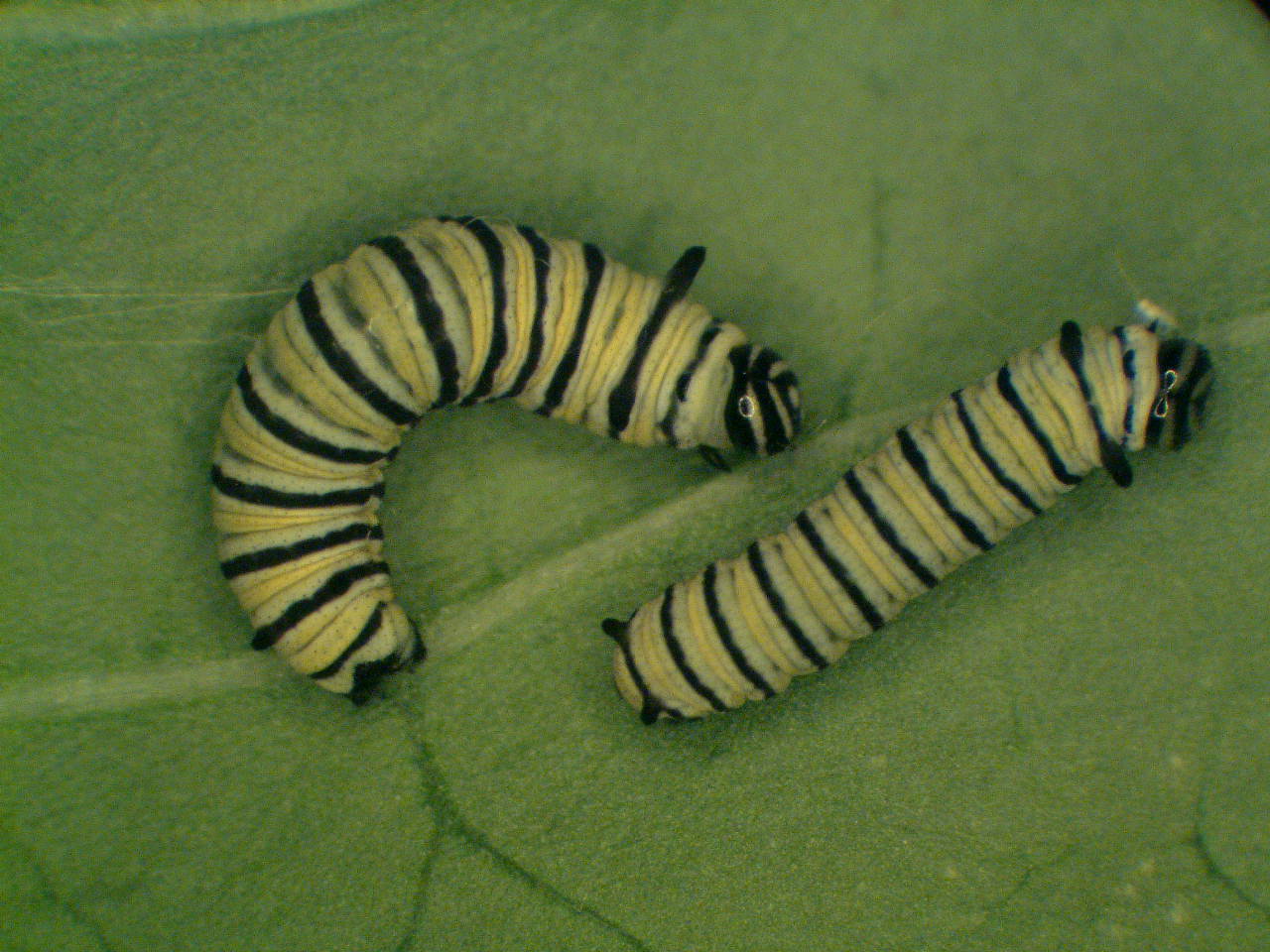
62. The way I learned MILKWEED was by going out with my mom and my grandma, looking for milkweed pods that had already gone to seed, popped open, and dried. I think they used them for craft projects. I don't know that I ever saw milkweed flowering until about 10 years ago when I we went on a flower-ID binge. When we were at Luwisomo one summer, it was just the right time for milkweed to flower, and we started looking for caterpillars. Monarch butterflies feed only on milkweed. We happened to find a chrysalis that was getting close to being done, so we brought it in and watched and waited for the butterfly to emerge. That was cool!

63. The flowers on GOATS BEARD are not remarkable. They look like dandelion or hawkweed, except that there are points that make it look a little more "starry" than the others. The time you recognize goats-beard, though, is when it goes to seed. The seedhead is reminiscent of a dandelion puffball, except it's airier. And bigger. The seedheads on goats-beard are the size of a baseball.

64. CURLY DOCK doesn't have burs like burdock. Instead it has a flower stalk that is a spiraling pillar. It will be green early in summer, but by this time of year curly dock is identified as the very dark brown, twisty weed along the roadsides.

65 & 66. One of the most beautiful sights in the world is a long ribbon of CHICORY and QUEEN ANNE'S LACE growing together in a lovely intertwining of blue and white. The kids taught me that chicory roots were used as a coffee substitute during the Civil War. And I taught them told them that Queen Anne's lace is also known as wild carrot. For those who have a hard time telling the difference between yarrow and Queen Anne's lace, the QA lace will have the small purple dot in the middle of the flowerhead, and it will make the "bird's nest" to protect its seeds from rain.

Sunday, August 17, 2008

"100" -- Nuisance

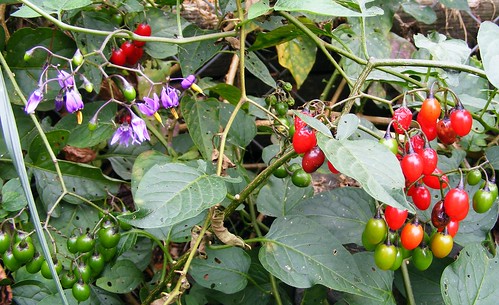
59. I think NIGHTSHADE is one of the reasons parents teach their children not to eat wild berries. The flowers are attractive. The plant looks tomato-like. But it's poisonous.


60. SOW THISTLE has flowers that look quite similar to dandelion, goats-beard, and hawkweed. Except it's a thistle. It is, however, a whole lot easier to pull than Canadian thistle or bull thistle.


61. These heart-shaped leaves just love to pop up in any disturbed soil: plowed fields, construction sites, gardens, or where you recently dug up your yard for a new septic system. You can see pictures of the various stages of growth of VELVETLEAF.

Saturday, August 16, 2008

"100" -- Rehashing

Here's a taller picture of burdock (#17) and also a picture of the flowers. I didn't know they were purple. I usually see them once they're dried and deeply entangled in the cats' fur.


Ragweed (#9) getting bigger and making lots of pollen now.


The bottom photo better shows the shape of grape leaves (#49).

Thursday, August 14, 2008

"100" -- Neighbors' Gardens

53. There's a little bit of DUSTY MILLER in the center of this planter.

54. These MARIGOLDS are the smaller kind. I'm not too fond of marigolds, but I suspect that if I manage to pull of some garden next year, I should plant some, to keep bunnies away. Although Athena-the-Huntress really is doing a bang-up job this summer!

55. The PETUNIAS are pink and white. I didn't plant any petunias this year because all I could find were the pink ones; I just love the brightly colored red and purple ones.


56. This picture was from the old house, but there's plenty of both around our new neighborhood too. The shrub in the background is FORSYTHIA, well past its early-spring bloom-time.

57. The SEDUM in the foreground flowers in fall, but the buds of what will become the pink flowers are already forming. I don't know why, but there's something I really like about succulents and their fat little leaves. This variety is called "Autumn Joy" sedum and is one of the most popular varieties for planting around homes or in borders.


58. We weren't sure what to plant by the lamp-post where we took out a very prickly and overgrown tree. Not getting started until way too late, and not knowing that SNAPDRAGONS take quite a while to grow when seeded directly into the soil, we didn't have any blooms until the last week of July. But it's starting to look quite cute out there in that little patch. And Jane tells me that her snapdragons come back year after year, so I have hopes of there being flowers next May or June, even if I don't get around to figuring out where I want daisies and other day-brighteners.

Tuesday, August 12, 2008

"100" -- More Eat-It (wild)

51. I have seen recipes for stir-frying PURSLANE or making it into pesto or putting it into salads. But I don't have too much of it around here. Well, a friend asked me to keep an eye on his garden while he was gone and to please keep his green beans picked. So we have plenty of beans to enjoy right now. He also warned me that his garden was full of pigweed, and that he'd started weeding but still had a long way to go. When I got there for my first batch of green beans, I discovered his "pigweed" was what I call purslane and which is the best plant-source of Omega 3's. So when I went back for my second round of bean-pickin', I gathered some of the greens too. The purslane pesto isn't as delicious as basil pesto or parsley pesto. But it's decent. The raw leaves, however, have a very nice, tangy, "fresh" taste to them. A few could really brighten up a lettuce salad. When Andrew reluctantly tried some, his eyes lit up and he said, "Hey, that's actually good!"


52. LAMB'S QUARTER is another weed, and I have plenty of it around here. Tasting them raw, I like its flavor better than the purslane. Plenty of pictures of lamb's quarter help a person be sure of what's he gathering before he begins to cook it and learn more about the plant in various stages of growth and how to use it for food. Jackie Clay had a whole article on greens not too long ago, including purslane and pigweed and lambs quarter.


I think it should go without saying, but just in case ...
NEVER eat plants you can't identify with certainty.
And NEVER eat plants that you've poisoned. Andrew was at the park one time and picked some white clover flowers, popped them into his mouth, and quickly spat them out. He said they tasted like a bag of chemical fertilizer. Well, yeah, that's what most people do to their lawns, and the city does the same thing to the park grass.
Also avoid eating these greens/weeds if there is a lot of chemical use in nearby soils that could be contaminating your plants. Using pesticides or herbicides on plants where you eat the fruit doesn't seem as dangerous as eating the leaves of plants that have been poisoned chemically treated.
Also remember that these weeds (not unlike spinach) tend to be so high in some nutrients when eaten raw that it is usually considered best to consume them only once a week.

Monday, August 11, 2008

"100" -- Poison Ivy

I'm not putting poison ivy on my list of species I can identify, because I'm miserable at identifying it. I've tried and tried to learn, but can't.

Tonight I was on a quest (a ten-year-old quest!) to identify a particular tree which I'd long ago narrowed down to the poplar genus, that is, either a quaking aspen or a cottonwood of some sort. While hunting, I stumbled upon a website that does the best job of showing poison ivy, explaining in words and pictures what it is, and how it varies throughout the year. I'm going to need to remember this site, and I thought somebody else might benefit too. Most guidance on recognizing poison ivy falls woefully short, telling us only "leaves of three, let it be." Well, then I'd avoid clovers and strawberries and all sorts of other good things. So I need lots more help in the ID dept, and this website is a step in the right direction!

"100" -- Eat It (Wild)

47. There are lots of people growing gardens around here with PEPPERS in them. But I can't very well go bopping into neighbors' yards with my camera. So when I saw this ornamental pepper plant at the library, I snapped a picture of it.


48. ELDER can be used for all sorts of things. There are medicinal uses, but I prefer just making jelly from the berries. Or if you happen to be a teenage boy, you might need to try to make yourself an elder-wand from the woody part of the shrub. But you would find the middle of the wood so soft as to be almost entirely useless as a wand or a stick. However, you would also discover the hollow core which would be the perfect place to put thestral hair...


49. A couple of years ago we were hiking up near Baraboo with some good friends. I'd been tending GRAPE vines in my backyard for years, pruning, watering, weeding, harvesting, and then jelly-making. Out hiking, in early October, we ran across a wild grape vine. I stopped Maggie and asked her identify the plant. She knew. Of course! It was grapes. She knew the leaves, the vines, the tendrils, and the fruit. So we picked a couple of grapes, popped them into our mouths, and kept on going. Just then, Kathy came around the bend in the trail and saw us eating something from the wild. She was sure we were going to die!!! I kept trying to point out to her that I wasn't eating something unknown. It was grape. I knew grape vines! But she wasn't convinced, and she wasn't about to let her daughter even think about eating one of those berries from the wild. Which is, granted, a good policy. You never never never never never eat what you don't know for sure is safe. (Willy Whitefeather tells how to figure out what is safe and what isn't if you're stuck in the wild and need food. But it's a procedure that will take at least several hours, and possibly more than a day.) I remember thinking that day that I must've learned something from those many years of tending my berries and vines. I may not know too much about gardening, but I do know the canes and vines I worked with; grape leaves (and the whole plant) is so distinctive that I can't imagine not recognizing it.

50. This is hard to find in the roadside grasses when it's first coming up in spring. I could never figure out how people knew where to hunt for asparagus along country roads. Every May we used to see people wading through knee-high grasses, with their knives, hunting for those little spears of ASPARAGUS popping up down by their ankles. But once I learned to recognize asparagus in summer and fall, it was easy to understand how people could make note of the location, and show up the following spring with their buckets and knives to nab some tasty veggies for dinner. The cornfield that's a half-mile from here has a lovely, lush row of asparagus dividing it from the soybeans in the next field. It looks like it's growing wild, and it looks like the land-owners probably don't bother with that patch. And I'm coveting it.... But I will be a good girl and plant my own, and in the meantime take any surplus asparagus that anybody at church wants to pass out!

Thursday, August 07, 2008

"100" -- Medicinal

42. Both the leaves and the flowerheads are much bigger in RED CLOVER than in white clover. And red clover doesn't have the gloriously sweet smell that white clover does. Red clover, though, is good for fighting cancer.


43. The purple coneflowers are ECHINACEA, the herb often used to support the immune system's response to viral infection.

44. The yellow flowers in the same picture are called rudbeckia. I kept trying to find out how they differed from BLACK-EYED SUSAN, until finally I discovered that one is the scientific name and the other is the common name for the same thing.


45. Remember what I said earlier about mint? Leaves in pairs, directly across from each other, and each pair offset from the pairs above and below it? And a square stem -- that's a huge clue to finding a mint. I put PEPPERMINT in my backyard at the parsonage; that's where this picture was taken. Mints can spread wildly and take over. That's why the former owner of this house had her mints in small planters. I haven't done much to keep them alive, but last time I checked, the peppermint wasn't a goner yet. It's nice to have mint around for tea or cooking ... or upset tummies. However, I prefer spearmint. My spearmint never "took" though.


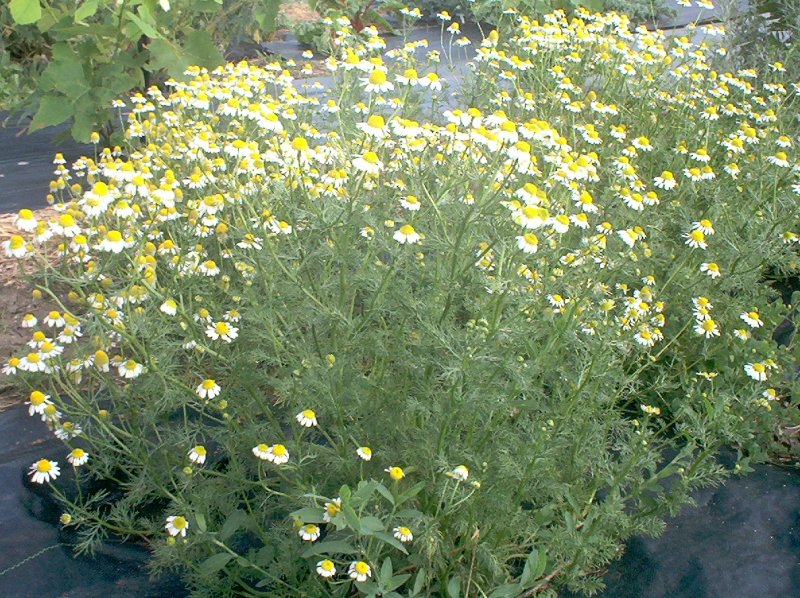
46. Good for soothing and calming; we find it in Sleepytime tea. Also good for upset stomachs, as Peter's mother told him after he'd eaten too much and gotten stressed out in Mr McGregor's garden. "She made some CHAMOMILE tea; and she gave a dose of it to Peter! One tablespoonful to be taken at bedtime. But Flopsy, Mospsy, and Cottontail had bread and milk and blackberries for supper."